
The first time I presented Patient Experience Management (PXM) and Voice-of-Patient (VoP) at a conference, I faced quite some scepticism in the room. Industry colleagues in the audience were saying, “this is not going to work for my disease area”, “for my country”, “… for my company”, etc., etc.
But I am happy to say: yes, it does! Due to regulatory limitations, possibly not in the same way everywhere, but in most disease areas, in most countries, for all kinds of companies, Patient Experience Management works very well. And this is not just a promise but increasingly real-world proof. For example, everything I am about to tell you below is based on real-life application and experience.
You are still not convinced? OK, here is a little boost of motivation. In 2013, a meta-analysis of 55 clinical studies published in BMJ showed consistent positive effects of patient experiences on the efficacy and safety of a treatment. Or in my words: the better the patients’ experiences, the better the treatment works with fewer side effects. Something that benefits everybody: patients, their families, doctors, nurses, and the treatment-providing company. And a 2022 report by DT Consulting stated that positive patient experiences lead to 3x higher probability of patient-support program (PSP) enrollment, whereas poor experiences result in 2x higher likelihood of switching medication. Motivated enough?
Quicklinks

What is Patient Experience Management?
‘Patient Experience Management’ is the application of general Customer Experience Management (CXM) methodologies and approaches to patients as customers, e.g., of the pharmaceutical industry, hospitals/medical centers, and professional healthcare providers. If you would like to know more about CXM, there’s a pretty good article by IBM people.
The ambition of PXM is to improve patients’ experiences, resulting in greater trust and confidence (e.g., in the treatment or care provided), better relationships, and, finally, more business. I really want to be very clear about this. PXM is not about being nice or an altruistic activity. Which might be a reason why some companies failed to get it up and running. Because PXM was simply not positioned as a business objective with clear business outcomes, but as a nice add-on to marketing strategy. PXM needs to be considered a strong business driver, not a nice-to-have. In my opinion, this is just a fair approach, actually a triple win as …
- Patients receive better care and service, are taken more seriously, and have their needs and expectations better addressed.
- Healthcare Professionals (doctors, nurses, pharmacists, caregivers) benefit when patients have greater trust and confidence in the treatment provided, resulting, for example, in higher treatment adherence and persistence.
- Pharmaceutical companies benefit from having more and better business. Which is fair, given the additional effort and investment.
Similar to CXM and VoC (“Voice-of-the-Customer“, customer feedback), some people use PXM synonymously for VoP (“Voice-of-the-Patient”). Which is not entirely correct or an oversimplification in both cases. But VoP is certainly a vital and central element of PXM, and there is no PXM without VoP. How can you improve the patient experience if you don’t know what patients’ experiences are?
Sidenote: I know that for some industry colleagues, calling patients “customers” might sound a bit provocative. But it is no secret that I am a strong proponent of pharmaceutical companies actively looking at and treating patients as customers. Not only for OTC providers, where this factually might be the case, but also for more B2B2C-driven businesses. More recently, some people in the industry started to call patients “consumers”, derived from CX language used in other industries, which I personally disapprove of. Who wants to be a “drug consumer”? But I don’t want to get lost in semantic considerations. So, in the PXM context, it might simply be the easiest to call patients “patients”. 🙂
Can you give me some tangible examples of PXM?
- Poor satisfaction metrics and anecdotal patient feedback on corporate websites indicate we need to take action to improve the content and usefulness of our digital channels to avoid wasted investment. In addition, VoP provides insights into segmentation by ‘reason for visit’, thereby enabling more personalized content.
- A patient providing feedback while participating in a clinical trial, complaining that the information materials provided are way too scientific for him to understand, and he is losing confidence in the treatment … giving us the opportunity to react based on knowing.
- Patient journeys and VoP guiding informed, targeted campaigns, enabling and securing impact-focused investments.
- Feedback from patients enrolled in a patient support program (PSP) guides improvements in PSP communication and service experiences, enhancing program effectiveness and brand reputation.
- Patient voices reveal a general acceptance issue with a new treatment based on a lack of trust and a poor understanding of treatment conditions, leading to high drop-off rates, providing guidance on more effective educational activities and support we need to provide.
All real-life examples of PXM happening today. Every single one of those allows for improving patient lives, continued treatment access, treatment adherence & persistence, trust & confidence, and corporate reputation. It is moving from guessing to knowing, and from ‘doing something for patients’ to real interactions and trusted relationships being beneficial for everybody.
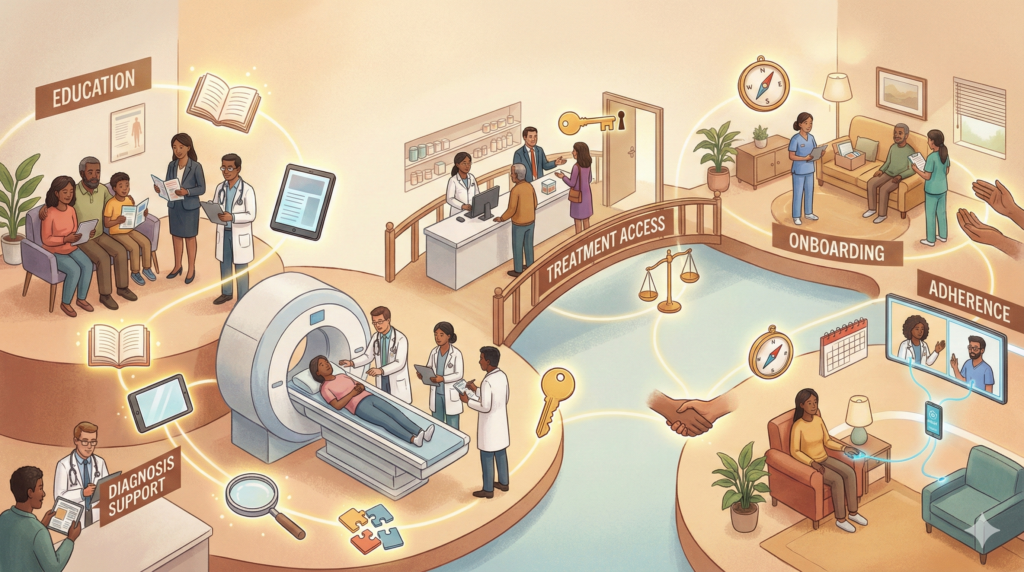
What are the building blocks of Patient Experience Management?
The elements of a PX strategy and framework are – analogous to CX – …
- PXM Vision – guidance to the company on why we are doing what we are doing.
- PXM Strategy, Governance & Operating Model – ensuring an enterprise approach and clarity on roles and responsibilities.
- Patient Personas – typically at the disease/product level, providing guidance on who to provide experiences to.
- Patient Journeys – providing guidance on where and when to efficiently and effectively provide experiences.
- PX Metrics – a corporate approach to measure and quantify actual experiences and compare with benchmarks.
- Voice-of-the-Patient (VoP) – a corporate approach to ask patients for their actual experiences.
- Closed-loop Taking Action Processes – enabling effective actions on feedback and measurements. (spoiler: this might be the most challenging piece to achieve)
I put it in the order I would personally apply for gradual development and expansion. Do one thing after the other. Also, allowing you to slow down a bit at any stage when you realize your organization is starting to get overwhelmed. If you lose your colleagues on the way, you will not succeed, as simple as that.
And just to mention it, AI is increasingly playing a pivotal role across most PXM building blocks, enabling things that were not possible before.
All these elements of the PXM framework deserve an in-depth examination, but that would go too far at this point. As soon as I have time, I will provide more details on each aspect. Or just feel free to contact me any time, or nudge me when crossing paths somewhere on this beautiful planet.
How is PXM different from CXM?
First of all, depending on your country, specific regulatory limitations will be in place restricting certain PXM activities, as governments and legislators consider themselves to have a duty of care towards patients. And this might be factually based on – guess what, yes – experiences with the pharma industry in the past, in this case, experiences of misconduct. In my personal opinion, …
- take it as a lesson about how strategically important it is to provide good experiences, and how long bad experiences can influence the relationship with customers (societies and governments included),
- and see the limitations as a feature that allows you to focus and invest smartly in what is possible.
Secondly, for patients, you might have to consider different experience areas, and derived from this, different metrics. For patients, ’empathy’ and the experience of being taken seriously in a challenging life situation weigh much higher than for professional B2B customers. In some disease areas, ’empathy’ might even be the #1 driver of experience. At the same time, ‘satisfaction’ and ‘efforts’ work very well with patients, too.
Furthermore, there is much more sensitivity around the privacy and security of (personal) patient data. Make your life easier by thinking very granularly about which data you really need and which you simply do not. Reduce data to the absolute minimum, and keep data only as long as necessary. For example, do you really need the patient’s name who is providing feedback on a website? For what? Is it required to take action on the feedback? Keep in mind that – for good reasons – most pharma companies have a ‘no personal data’ policy, at least for patients outside the US.
There are more considerations, e.g., regarding potential adverse event reporting in feedback, which are more basic and not really patient-specific. But they might require greater attention and involvement, as well as compliance with patient-engagement-specific corporate processes and policies. I assume that everyone working in the pharma industry is fully aware of and well-trained in those general expectations. In cases of doubt, your ‘Patient Affairs’ (‘Patient Advocacy’, ‘Patient Engagement’) department will provide proper guidance.
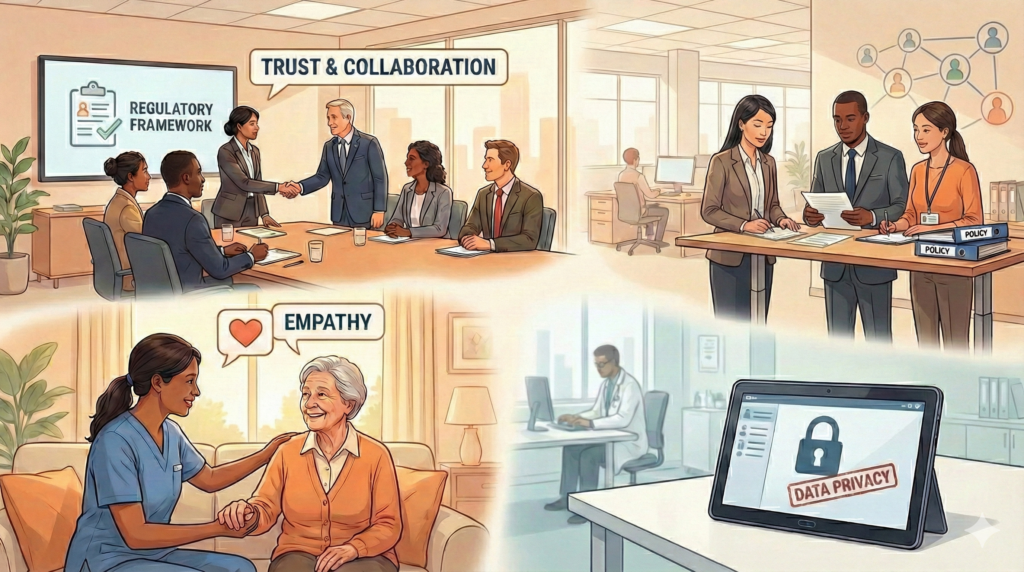
How to get Patient Experience Management up and running?
1st Start. Yes, just start. Don’t let “this does not work for us” myths hold you back. Don’t be slowed down by the faint-hearted skeptics. Progress happens by walking, not by taking.
2nd Have a clear and agreed-upon corporate business rationale for your PXM in place. Define specific, concrete, and measurable business outcomes. And have a compelling business story to tell when someone asks Why are we doing this?‘ The ‘what’ and the ‘how’ are important. The ‘why’ is vital.
3rd Recruit senior management as your advocates. Tactically, this can depend on what you actually plan to do. A PXM pilot in a ‘contained’ space, like a specific disease area? Then you will need to win critical stakeholders like the commercial lead, the medical director, eventually the DA/TA head, and, certainly, patient affairs, as your friends and allies. PXM as an enterprise ambition will need the CEO and C-suite strongly supporting it.
4th Always involve your corporate ‘Patient Affairs’ and compliance departments from the outset. This should be a no-brainer. My focus is on the “from the outset”. The earlier representatives of those (and likely other) functions have a seat at the table, the easier your life is going to be downstream. I promise.
5th Do one thing after the other. Implement one CXM building block at a time. This does not release you from having an overall architectural plan for your PXM and building each block so that it will finally seamlessly integrate into the whole system. But don’t get accidentally sidetracked; you might want to check that piece A actually works well before investing in piece B. And some pieces simply depend on each other. For example, it doesn’t really make sense to set up Voice-of-Patient (patient feedback) before having a corporate PX metric.
6th Tell the story over and over again. And when you reach the point where you think you’re stupid for telling the story yet another time, and you can’t even listen to it yourself anymore … this is the point where colleagues start to understand you even have to intensify your storytelling.
Last … but not least, how about hiring an experienced specialist?! Try-and-error is a nice approach if you have ample time and resources. But to “inoculate” the activity with some expertise will certainly not hurt, and get you to actual achievements quicker. Or are you asking a plumber – and it might be the best plumber on planet – to do an electrician’s work?
More on Patient Experience Management …
- MAPS members can watch a recorded discussion (webinar) on “PXM & the Evolution of Digital Patient Engagement“ between my esteemed colleague Jörg Corsten and me on the MAPS member portal (“MAPS Knowledge Center”) (2025).
- Rx4Cx, a Life Science CX/PX newsletter @LinkedIn by the famous Richard Schwartz.
- “Innovations in Patient CX” by the Digital Health Coalition (2024).
- “The State Of Customer Experience In The Pharmaceutical Industry, 2022: Patient Interactions” by Dominic Tyer with Tim van Tongeren and Hannah Price, DT Consulting (2023).
- “BioPharma leaders: Are you prepared for the next patient engagement (r)evolution?” by Russell Reynolds Associates (2024).
- “Patient Experience in Pharma: What Today’s Leaders Must Know” by P350 (2025).
- “What Is Patient Experience? – Anthony Pannozzo’s view” (2019)
- “A systematic review of evidence on the links between patient experience and clinical safety and effectiveness”, Cathal Doyle,
Laura Lennox & Derek Bell (2013) in BMJ Open. https://doi.org/10.1136/bmjopen-2012-001570 - Article about patient-experience-centered healthcare with less industry and more provider focus: “Improving the Patient Experience in Healthcare: The Role of Care Management” by Jon-Michial Carter from ChartSpan.
- The Patient Experience Journal, published by The Beryl Institute.
- Very much in the details of patient experiences in the context of a specific disease: The Journal of Patient Experience, published by Sage Journals.